







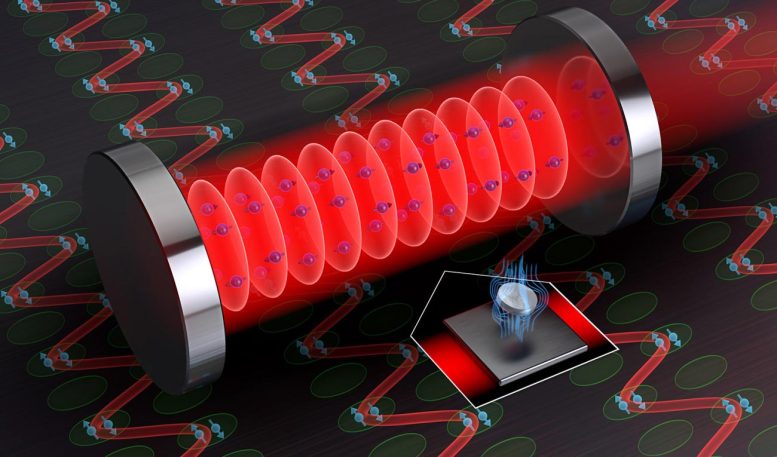
Researchers observed the dynamic phases of BCS superconductor interactions in a Cavity QED by measuring the light leakage from the cavity. Credit: Steven Burrows/Rey and Thompson Groups
New insights can help scientists make superconducting materials more robust and useful.
Superconductors have enabled new technologies for health care, transportation, and scientific exploration.Scientists want to know how superconductors react to sudden changes, such as jumps in temperature, to gain insights on how to make them more robust.NIST and JILA physicists used strontium atoms to simulate a superconductor, allowing them to observe a behavior that had been predicted for years.Introduction to Superconductivity
Superconductivity makes physics seem like magic. At cold temperatures, superconducting materials allow electricity to flow indefinitely while expelling outside magnetic fields, causing them to levitate above magnets. MRIs, maglev trains, and high-energy particle accelerators use superconductivity, which also plays a crucial role in quantum computing, quantum sensors, and quantum measurement science. Someday, superconducting electric grids might deliver power with unprecedented efficiency.
Challenges with Superconductors
Yet scientists lack full control over conventional superconductors. These solid materials often comprise multiple kinds of atoms in complicated structures that are difficult to manipulate in the lab. It’s even harder to study what happens when there’s a sudden change, such as a spike in temperature or pressure, that throws the superconductor out of equilibrium.
Quantum theory has predicted intriguing behaviors when a superconductor is driven out of equilibrium. However, it has been challenging to perturb these materials in the lab without disrupting their delicate superconducting properties, leaving these predictions untested.
JILA’s Innovative Research
However, scientists can obtain surprisingly deep insights into superconductivity by studying it with fully controllable arrays of atoms in a gas. That is the approach of a research collaboration at JILA, a joint institute of the National Institute of Standards and Technology (NIST) and the University of Colorado Boulder.
In their latest work, JILA researchers caused a gas of strontium atoms to act like a superconductor. Even though the strontium atoms themselves are not superconducting, they follow the same rules of quantum physics. The researchers could make atoms in a gas interact in a way that preserves the sorts of interactions responsible for superconductivity while suppressing other competing, complex interactions. By throwing the atoms out of equilibrium, the researchers saw changes in atomic interactions that would affect the properties of actual superconductors.
With their strontium gas acting as a “quantum simulator,” the researchers were able to observe a behavior of superconductors that has been predicted to exist for years. This study, published in Nature, offers new insight into how superconductors work when appropriately driven out of equilibrium, and sheds light on how to make superconductors more robust, and how to use their unique properties in other quantum technologies.
‘How Robust Are These Things?’
In a normal material, electrons move in an incoherent way, bumping into one another constantly; normally, electrons repel each other. As they move, they collide, losing energy and generating heat; that’s why electric currents dissipate when electrons flow in a metallic wire. In a superconductor, however, electrons join up into weakly bonded pairs, called Cooper pairs. When these pairs form, they all tend to move coherently, and that is why they flow through the material with no resistance.
The physics is simple in some sense, explains theoretical physicist Ana Maria Rey, a NIST and JILA Fellow. Cooper pairs exist in a low-energy state because vibrations in the material’s crystalline structure pull the electrons together. When formed, Cooper pairs prefer to act coherently and lock together. The Cooper pairs are kind of like “arrows” that want to line up in the same direction. To unlock them or make one of the arrows point along a different direction, you need to add extra energy to break the Cooper pairs, Rey explains. The energy that you need to add to unlock them is called an energy gap. Stronger interactions between the atoms create a larger energy gap because the attraction that keeps the Cooper pairs locked is so strong. Overcoming that energy gap takes a lot of energy away from the Cooper pairs. So this energy gap acts as a buffer, letting the Cooper pairs remain happily locked in phase.
This all works when the system is in equilibrium. But when you introduce a sudden, rapid change, the superconductor falls out of equilibrium, or becomes “quenched.” For decades, scientists have wanted to know what happens to superconductivity following a quench that is abrupt but not so strong to completely break the Cooper pairs, said JILA physicist James Thompson.
“In other words, how robust are these things?” Thompson said.
Theorists predicted three different possibilities or phases that could happen when the superconductor is quenched. Think of it like a big group of square dancers, Thompson says. At first everyone is in sync, keeping to the beat of the music. Then some people get a little tired or some others start moving a little too fast, they crash into each other, and it turns into a mosh pit. That’s Phase I, when superconductivity collapses. In Phase II, the dancers get off the beat, but manage to stay in sync. Superconductivity survives the quench. Scientists have been able to observe and study these two phases.
But they have never seen a long-predicted third phase, in which the superconductivity of the system oscillates over time. In this phase, our dancers will move a bit faster or a bit slower at times, but no one crashes. That means sometimes it’s a weaker superconductor, and sometimes it’s a stronger superconductor. Until now, no one had been able to observe that third phase.
‘Everything Flows’
Working with Rey’s theory group, Thompson’s team at JILA laser-cooled and loaded strontium atoms into an optical cavity, a space with highly reflective mirrors at either end. Laser light bounces back and forth millions of times before some light leaks out at one end.
The light in the cavity mediated interactions between the atoms, causing them to align into a superposition state — meaning they are in both the excited and ground state at the same time — and to lock in phase, like Cooper pairs do, Rey explains.
Using lasers, scientists can quench the system, and by measuring the light that leaks out, they learn how the energy gap has changed over time. With this quantum superconductor simulation, they were able to observe all three dynamic phases for the first time.
They found that in the third phase the energy gap can keep superconductivity going even when the system is out of equilibrium. Using quantum simulators like this could help scientists engineer unconventional or more robust superconductors, and better understand the physics of superconductors in general.
It’s also a counterintuitive way for scientists who work in measurement science to see atomic interactions, like the ones that cause the energy gap, as a benefit, not a curse.
“In measurement science, interactions are usually bad. But here, when interactions are strong, they can help you. The gap protects the system — everything flows,” Rey says. “At the heart of this idea you could have something that oscillates forever.”
Having something that oscillates forever is a dream for quantum technology, Thompson adds, because it would let sensors work better for longer. Much like the superconductors, groups of atoms, photons and electrons in quantum sensors need stay in sync, or coherent, to work, and we don’t want them to turn into a quantum mosh pit or “dephase.”
“I am stoked that one of the dynamical phases that we observe can be used to protect quantum optical coherence against dephasing. For instance, this may one day allow an optical atomic clock to tick for longer,” Thompson said. “It represents a whole new way to increase the precision and sensitivity of quantum sensors, a topic that is at the frontier of quantum metrology, or measurement, science. We want to harness the many atoms and take advantage of the interactions to build a better sensor.”
Reference: “Observing dynamical phases of BCS superconductors in a cavity QED simulator” by Dylan J. Young, Anjun Chu, Eric Yilun Song, Diego Barberena, David Wellnitz, Zhijing Niu, Vera M. Schäfer, Robert J. Lewis-Swan, Ana Maria Rey and James K. Thompson, 24 January 2024, Nature.
DOI: 10.1038/s41586-023-06911-x
>>> Read full article>>>
Copyright for syndicated content belongs to the linked Source : SciTechDaily – https://scitechdaily.com/strontium-unlocks-the-quantum-secrets-of-superconductivity/



