







This article is republished from The Conversation.
The Navajo Nation, the largest Native American reservation in the U.S., covers 27,000 square miles (70,000 square kilometers) in the Southwest – an area larger than 10 states. Today it is home to more than 250,000 people – roughly comparable to the population of St. Petersburg, Florida, or Winston-Salem, North Carolina.
Unlike those cities, however, 30% of households on the Navajo Reservation lack running water. Hauling water can cost 20 times what it does in neighboring off-reservation communities. While the average American uses between 80 and 100 gallons (300-375 liters) of water per day, Navajo Nation members use approximately seven.
Since the 1950s, the Navajo Nation has pressed the U.S. government to define the water rights reserved for them under the 1868 treaty that created their reservation.
These efforts culminated in a U.S. Supreme Court case, Arizona v. Navajo Nation, which posed this question: Does the treaty between the Navajo Nation and the United States obligate the federal government to “assess” the water needs of the Navajo and “make a plan” for securing water to meet those needs? On June 22, 2023, the Supreme Court ruled 5-4 that the answer was no.
The centrality of water rights
Water rights – the ability of individuals to use public water supplies – have always been a central issue in the U.S. West. They are only becoming more so as drought and climate change shrink the existing supply.
Federal reserved rights have special importance with respect to American Indian reservations for several reasons.
First, the priority date when the rights begin is the date when the reservation was created. In most cases, this creates a very senior right – one that supersedes those of people who arrive in the area later.
Second, these rights exist regardless of whether the tribe has begun to use the water. Because all of the water in many western rivers has been fully allocated, these rights have a significant potential to displace existing juniors, or people who came later and have rights under state water law.
Third, among the 30 federally recognized tribes in the Colorado River Basin, approximately a dozen – including the Navajo Nation – are still in the process of getting a court to adjudicate the scope of their federal water rights.
Finally, tribes or nations usually need a lot of water to irrigate reservation lands or establish a viable permanent homeland in the dry Southwest. In this context, it’s clear why the Navajo have called on the federal government for decades to specify their federally reserved water rights.
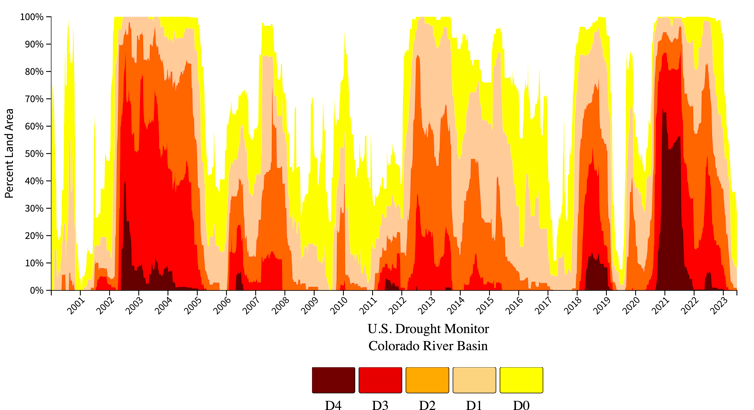 The Colorado River Basin, which includes parts of seven states, has been in severe drought for more than 20 years, intensifying competition over water rights. Drought levels range from D0 (Abnormally Dry) to D4 (Exceptional Drought)
U.S. Drought Monitor
Does a ‘permanent home’ imply access to water?
The Navajo quest for a clear determination of their water rights is rooted in America’s history of removing Native Americans from their lands and moving them to areas with fewer resources.
As Justice Neil Gorsuch recounted in a detailed dissent in this case, the U.S. government embarked in the 1860s on a program of “removal, isolation, and incarceration” to force the Navajo to vacate lands so they could be settled by whites. Thousands of U.S. troops roamed Navajo lands, destroying everything they could.
After the Navajo surrendered in 1864, they were forcibly relocated 300 miles to Bosque Redondo, a barren area of eastern New Mexico. Many Navajo died on the “Long Walk,” and more perished over the next four years.
In 1868, the Navajo agreed to a treaty that created a reservation on a portion of their original lands as a “permanent homeland.” The U.S. government promised to provide seeds, agricultural implements, sheep and goats, but the treaty made no explicit reference to water.
Forty years later, the Supreme Court issued a ruling in Winters v. United States that became a guidepost for understanding tribes’ and nations’ federal reserved water rights. The U.S. had established the Fort Belknap Indian Reservation in Montana for the Gros Ventre and Assiniboine tribes, and subsequently sued irrigators in Wyoming who built canals and reservoirs on the Milk River upstream from the reservation.
The Supreme Court recognized that the 1888 agreement that had created the Fort Belknap reservation did not mention water, but observed that “[t]he lands were arid, and without irrigation, were practically valueless.” The justices concluded that the implication or inference was that Congress intended to reserve enough water for the tribes to have a “permanent home.”
“The status quo is going to continue. Being disappointed by the federal government is nothing new in Indian Country.”
SCOTUS rules on Navajo Nation water case: https://t.co/c5ikHS2vB0
— Luke Runyon (@LukeRunyon) June 22, 2023
What does the 1868 treaty require?
Beginning in 1956, the Navajo Nation filed a series of motions to participate in Arizona v. California, the Supreme Court’s historic ruling on Colorado River water rights for California, Arizona and Nevada and five Indian tribes – not including the Navajo.
Over the next several decades, the Navajo repeatedly attempted to get the federal government to assess their water rights to the main stream of the Colorado River. Finally, in 2003, the Navajo Nation filed the current suit.
In the ruling, Justice Brett Kavanaugh refused to find that the 1868 treaty satisfied the Winters framework. The 1868 treaty “reserved necessary water to accomplish the purpose of the Navajo Reservation. But it did not require the United States to take affirmative steps to secure water for the Tribe,” Kavanaugh wrote for the majority. “Nor is it the role of the Judiciary to rewrite a 155-year-old treaty.” That job, Kavanaugh asserted, fell to Congress.
Gorsuch – joined by Justices Sonia Sotomayor, Elena Kagan and Ketanji Brown Jackson – dissented. Gorsuch is widely recognized as an expert on Indian law, including water rights, and is the only member of the Court who grew up west of the Mississippi River.
In Gorsuch’s view, the promise of a permanent homeland, together with the history surrounding the treaty and background principles of Indian law, was enough to conclude that the 1868 treaty – following the principle set out in Winters v. United States – secured some water rights for the Navajo.
The Navajo “have written federal officials. They have moved this Court to clarify the United States’ responsibilities when representing them. They have sought to intervene directly in water-related litigation,” Gorsuch wrote. “And when all of those efforts were rebuffed, they brought a claim seeking to compel the United States to make good on its treaty obligations by providing an accounting of what water rights it holds on their behalf.”
“At each turn, they have received the same answer: ‘Try again.’ When this routine first began in earnest, Elvis was still making his rounds on The Ed Sullivan Show,” Gorsuch observed.
What’s next for the Navajo?
Arizona, California and Nevada all intervened in this case to protect their interests in the Colorado River. Because the American West is so arid, water rights often are a zero-sum game. Any judicially recognized rights for the Navajo from the Colorado River would reduce water available to the states.
This ruling solidifies the states’ Colorado River water rights and indefinitely postpones resolution of the Navajo Nation’s claims.
Meanwhile, the Navajo suffer. Lack of access to clean water contributed to high death rates on the reservation during the COVID-19 pandemic. More than 150 years after their reservation was created, the Navajo quest for water rights continues.
This article is republished from The Conversation under a Creative Commons license. Read the original article.
>>> Read full article>>>
Copyright for syndicated content belongs to the linked Source : Popular Science – https://www.popsci.com/environment/supreme-court-navajo-water/



