







Weekly chess lessons aren’t part of most elementary grades’ schedules. But they’re not the only thing that sets apart Harlem Academy, a K-8 private school for gifted kids in New York City. Even more unusual, in the world of advanced education, are the school’s demographics: Close to three-quarters of students are low-income, and nearly all are students of color.
For years, gifted programs and schools have been criticized for underrepresenting low-income students, and Black, Hispanic, and Indigenous students, in particular. Across the United States, just 2% of students from the lowest income quintile receive gifted services, compared with 13% of students from the highest quintile.
Why We Wrote This
A story focused on
How can the United States make sure all students who are capable of advanced work are given that opportunity? Politicians and educators are leaning toward gifted programs that are more inclusive.
Those gaps have been blamed on both a shortage of accelerated programs in high-poverty schools and problems with the way schools screen for talent. They have led some skeptics of gifted education – including former New York City Mayor Bill de Blasio – to call for its elimination. Gifted-education advocates say the solution is instead to open programs up to more students.
Both sides of the debate agree on one thing: The country would be in a better position if schools helped all students reach their highest potential. And that failing to do so squanders huge amounts of human capital.
In a fifth grade classroom in central Harlem, chess coach Tommy Zhang is teaching a group of 10- and 11-year-olds an opening called the fried liver attack.
These students are no beginners – they’ve been studying chess since kindergarten – and they catch on quickly. They eagerly direct Mr. Zhang’s moves on the hanging chess board at the front of the classroom. Then they pair off to practice.
Weekly chess lessons aren’t part of most elementary grades’ schedules, but they’re not the only thing that sets apart Harlem Academy, a K-8 private school for gifted kids. Even more unusual, in the world of advanced education, are the school’s demographics: Close to three-quarters of students are low-income, and nearly all are students of color.
Why We Wrote This
A story focused on
How can the United States make sure all students who are capable of advanced work are given that opportunity? Politicians and educators are leaning toward gifted programs that are more inclusive.
For years, gifted programs and schools have been criticized for underrepresenting low-income students, and Black, Hispanic, and Indigenous students, in particular. Across the United States, just 2% of students from the lowest income quintile receive gifted services, compared with 13% of students from the highest quintile.
Those gaps have been blamed on both a shortage of accelerated programs in high-poverty schools and problems with the way schools screen for talent. They have led some skeptics of gifted education – including former New York City Mayor Bill de Blasio – to call for its elimination.
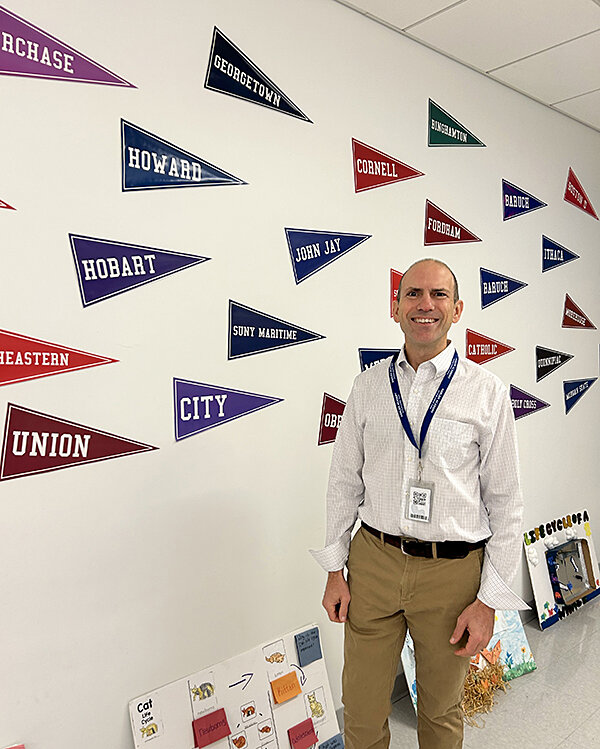
Vincent Dotoli, founder and head of school at Harlem Academy, stands in front of pennants showing colleges attended by graduates.
But gifted-education advocates say the solution is not to abolish advanced programs, but to open them up to more students. This approach has been embraced by New York’s current mayor, Eric Adams. He recently expanded the city’s Gifted & Talented program to all 32 districts, while permanently scrapping the use of a kindergarten screening test.
Other cities are also wrestling with the question of whether to end or to extend advanced education in elementary and middle school. In Boston, the fight pits proponents of separate classrooms for advanced students against those who prefer a schoolwide enrichment model. And in San Francisco, parents are pushing the district to overturn a decade-old decision to delay Algebra I until high school. The policy has hurt high-achieving students, they say, and has done little to close racial gaps in access to advanced math.
Both sides of the debate over gifted education agree on one thing, though: The country would be in a better position, both socially and economically, if schools helped all students reach their highest potential. And that failing to do so squanders huge amounts of human capital.
“Too many students start school with dreams and aspirations of what their future can look like, and very early on, they’re met with the reality of what it will be,” says Jonathan Davis, director of research for the Equity Research Cooperative.
Space race origins
Gifted education got its start in a New York City classroom a century ago. But it took off during the Cold War, amid fears that the U.S. was falling behind Russia in the space race. In 1958, Congress passed the National Defense Education Act, setting aside funds for the testing and identification of talented students who might form an “elite generation” of scientists and engineers.
A second wave of gifted programs came along in the 1970s, following the publication of the Marland Report, which established a federal definition of giftedness.
But the field has long been dogged by concerns that its admissions practices discriminate against low-income students and contribute to segregation in the nation’s public schools.
Until fairly recently, most gifted-education programs admitted students based on teacher and parent recommendations and scoring on a test. That approach tends to favor children whose parents have the social capital to advocate for their kids and the money to invest in tutoring and test prep. It is also susceptible to teacher bias, says Jonathan Plucker, a professor of education at Johns Hopkins University.
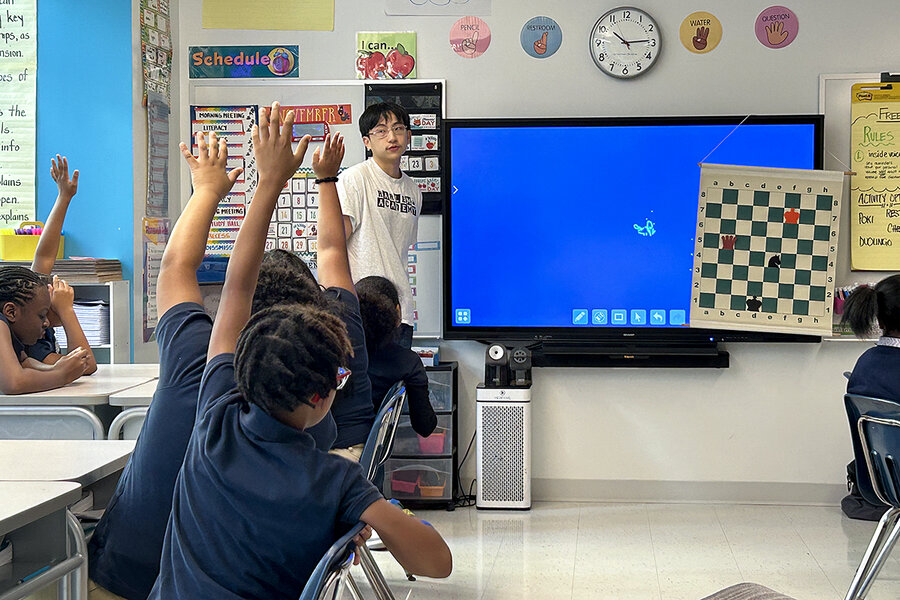
Fifth graders at Harlem Academy raise their hands Nov. 27, 2023, to tell chess coach Tommy Zhang where to move the chess pieces on a hanging board.
“With kids of color, you’re dealing with stereotypes affecting how kids are seen in the classroom,” says Angel Gonzalez, head of school at De La Salle Academy, a private middle school for gifted, low-income kids in New York City. In some classrooms, outspoken boundary-pushers are viewed as defiant, rather than bright, he says.
Dr. Plucker says that when he visits high-poverty schools, teachers often tell him they have no advanced students.
“Even when they’re beating the odds and performing at high levels, they get overlooked,” Dr. Plucker says. “It’s this idea that ‘this is not what a bright kid looks like.’”
Serving students better
In an effort to capture more of these students, New York City and a growing number of schools nationwide are shifting to universal screening for giftedness, an approach considered controversial even a decade ago, Dr. Plucker says. Some teacher preparation and professional development programs are devoting more time to training educators to recognize latent talent, too.
But many programs still gloss over gifted education. The threshold for admission into advanced programs also remains out of reach for many low-income students, whose test scores often reflect their limited educational opportunities.
Recognizing this, some advocates for advanced education are pushing gifted programs to adopt “local norms” for admitting students. Comparing students with their peers, for example, instead of against a districtwide or national standard.
“If you’ve got a kid scoring at the 80th percentile, and most of their peers are at the 20th, they’re way ahead,” says Mike Petrilli, president of the Thomas B. Fordham Institute. His organization convened a bipartisan working group on advanced education, which in June 2023 released a report with dozens of recommendations on diversifying the pipeline. “We’ve got to come up with a way to serve that student better,” he says.
At Harlem Academy, admission is based on a combination of test scores, grades, and an in-person, task-based assessment. Students enter with a median standardized test score in the 74th percentile – a level that would not make the cut for most gifted programs. They reach close to the 90th percentile by the time they finish eighth grade. Nearly all go on to selective high schools and four-year colleges.
Vincent Dotoli, who started the school in a church basement 20 years ago, attributes its success to a focus on the fundamentals of reading, writing, and math. He also points to high staffing levels, which enable teachers to tailor instruction to individual students’ strengths and struggles. The school has 19 teachers and 170 students, a ratio of about 1-to-9.
“The biggest thing is ensuring that every student feels challenged in a way that is appropriate for them,” Mr. Dotoli says.
But differentiation can be difficult to do in high-poverty public schools with large classrooms. Overwhelmed teachers are focused on getting the weakest students to basic levels of literacy and numeracy, and advanced learners can be an afterthought. Nationally, almost a third of schools offer no gifted programming.
“A good support system”
New York City’s poorer neighborhoods have long had fewer options for gifted kids than its wealthier ones have had. Even with the mayor’s recent addition of 100 new kindergarten seats, there are still twice as many gifted programs per kindergartener in the wealthiest districts than in the lowest-income ones, an analysis by Mr. Dotoli found.
While specialized schools like Harlem Academy can help fill some of that gap, its small size limits its impact.
Still, the school is making a difference to students like eighth graders Kadin, who says he no longer has to pretend he doesn’t understand things to fit in, and Taylor, who says she’s never bored.
“Your teachers force you to think deeper and find meanings below the surface,” says Kyoncee, another eighth grader. “But they’re a good support system and help guide you along the way.”
>>> Read full article>>>
Copyright for syndicated content belongs to the linked Source : The Christian Science Monitor – https://www.csmonitor.com/USA/Education/2024/0103/What-does-a-bright-kid-look-like-New-York-expands-its-gifted-program?icid=rss



