





* . *
  • About
  • Advertise
  • Privacy & Policy
  • Contact
Thursday, June 18, 2026
Earth-News
  • Home
  • Business
  • Entertainment

    Explosive Fourth of July Celebration Bursting with Rodeo Thrills and Destruction Derby Excitement

    Stephen Colbert’s Final ‘Late Show’ Peanuts Stunt Triggers Surprising Fallout

    Miramis Appoints New Head of Entertainment Ahead of Gasometer Stockholm Launch

    Deadly Helicopter Crash in Brazil Claims Six Lives; Authorities Launch Urgent Investigation

    Unforgettable Highlights from the 2026 Cincinnati Concours d’Elegance at Ault Park

    Redding’s Downtown Entertainment Zone Marks Six Months of Thrilling Fun

  • General
  • Health
  • News

    Cracking the Code: Why China’s Economic Challenges Aren’t Shaking Markets, Unlike America’s” – Bloomberg

    Trump’s Narrow Window to Spread the Truth About Harris

    Trump’s Narrow Window to Spread the Truth About Harris

    Israel-Gaza war live updates: Hamas leader Ismail Haniyeh assassinated in Iran, group says

    Israel-Gaza war live updates: Hamas leader Ismail Haniyeh assassinated in Iran, group says

    PAP Boss to Niger Delta Youths, Stay Away from the Protest

    PAP Boss to Niger Delta Youths, Stay Away from the Protest

    Court Restricts Protests In Lagos To Freedom, Peace Park

    Court Restricts Protests In Lagos To Freedom, Peace Park

    Fans React to Jazz Jennings’ Inspiring Weight Loss Journey

    Fans React to Jazz Jennings’ Inspiring Weight Loss Journey

    Trending Tags

    • Trump Inauguration
    • United Stated
    • White House
    • Market Stories
    • Election Results
  • Science
  • Sports
  • Technology

    How Satellite Technology Is Transforming the Future of Global Drinking Water Protection

    Why the Most Game-Changing Innovation of the Next Decade Could Surprise You

    FC Barcelona Launches Its First Signature Fragrance, Fusing Emotion, Memory, and Innovation

    SLU-Madrid Elevates Tech Training Through Exciting Cisco Networking Academy and PUE Academy Collaboration

    Discover How a Simple Saliva Test Can Reveal Hidden Signs of Sleep Loss

    DNA Technology Reveals the Truth Behind a 25-Year-Old Mystery in Olympic National Park

    Trending Tags

    • Nintendo Switch
    • CES 2017
    • Playstation 4 Pro
    • Mark Zuckerberg
No Result
View All Result
  • Home
  • Business
  • Entertainment

    Explosive Fourth of July Celebration Bursting with Rodeo Thrills and Destruction Derby Excitement

    Stephen Colbert’s Final ‘Late Show’ Peanuts Stunt Triggers Surprising Fallout

    Miramis Appoints New Head of Entertainment Ahead of Gasometer Stockholm Launch

    Deadly Helicopter Crash in Brazil Claims Six Lives; Authorities Launch Urgent Investigation

    Unforgettable Highlights from the 2026 Cincinnati Concours d’Elegance at Ault Park

    Redding’s Downtown Entertainment Zone Marks Six Months of Thrilling Fun

  • General
  • Health
  • News

    Cracking the Code: Why China’s Economic Challenges Aren’t Shaking Markets, Unlike America’s” – Bloomberg

    Trump’s Narrow Window to Spread the Truth About Harris

    Trump’s Narrow Window to Spread the Truth About Harris

    Israel-Gaza war live updates: Hamas leader Ismail Haniyeh assassinated in Iran, group says

    Israel-Gaza war live updates: Hamas leader Ismail Haniyeh assassinated in Iran, group says

    PAP Boss to Niger Delta Youths, Stay Away from the Protest

    PAP Boss to Niger Delta Youths, Stay Away from the Protest

    Court Restricts Protests In Lagos To Freedom, Peace Park

    Court Restricts Protests In Lagos To Freedom, Peace Park

    Fans React to Jazz Jennings’ Inspiring Weight Loss Journey

    Fans React to Jazz Jennings’ Inspiring Weight Loss Journey

    Trending Tags

    • Trump Inauguration
    • United Stated
    • White House
    • Market Stories
    • Election Results
  • Science
  • Sports
  • Technology

    How Satellite Technology Is Transforming the Future of Global Drinking Water Protection

    Why the Most Game-Changing Innovation of the Next Decade Could Surprise You

    FC Barcelona Launches Its First Signature Fragrance, Fusing Emotion, Memory, and Innovation

    SLU-Madrid Elevates Tech Training Through Exciting Cisco Networking Academy and PUE Academy Collaboration

    Discover How a Simple Saliva Test Can Reveal Hidden Signs of Sleep Loss

    DNA Technology Reveals the Truth Behind a 25-Year-Old Mystery in Olympic National Park

    Trending Tags

    • Nintendo Switch
    • CES 2017
    • Playstation 4 Pro
    • Mark Zuckerberg
No Result
View All Result
Earth-News
No Result
View All Result
Home Science

What ended the ‘dark ages’ in the early universe? New Webb data just brought us closer to solving the mystery

March 3, 2024
in Science
What ended the ‘dark ages’ in the early universe? New Webb data just brought us closer to solving the mystery
Share on FacebookShare on Twitter

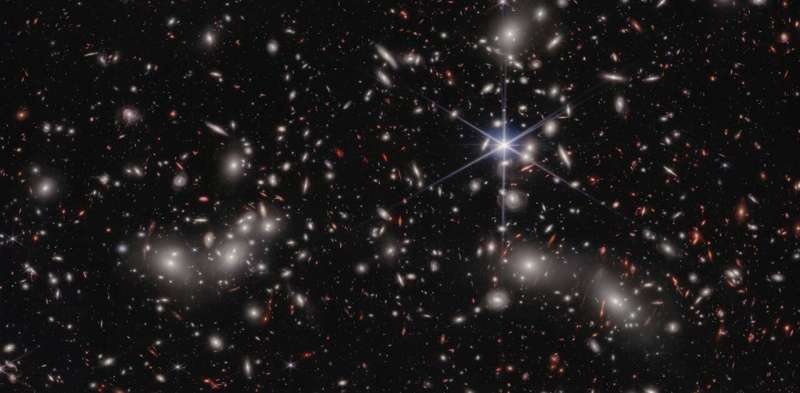
What ended the 'dark ages' in the early universe? New Webb data just brought us closer to solving the mystery

Credit: NASA / ESA / CSA / Ivo Labbe (Swinburne) / Rachel Bezanson (University of Pittsburgh) / Alyssa Pagan (STScI)

About 400,000 years after the Big Bang, the cosmos was a very dark place. The glow of the universe’s explosive birth had cooled, and space was filled with dense gas —mostly hydrogen—with no sources of light.

Slowly, over hundreds of millions of years, the gas was drawn into clumps by gravity, and eventually, the clumps grew big enough to ignite. These were the first stars.

At first their light didn’t travel far, as much of it was absorbed by a fog of hydrogen gas. However, as more and more stars formed, they produced enough light to burn away the fog by “reionizing” the gas—creating the transparent universe dotted with brilliant points of light we see today.

But exactly which stars produced the light that ended the dark ages and triggered this so-called “epoch of reionization”? In research published in Nature, we used a gigantic cluster of galaxies as a magnifying glass to gaze at faint relics of this time—and discovered that stars in small, faint dwarf galaxies were likely responsible for this cosmic-scale transformation.

What ended the dark ages?

Most astronomers already agreed that galaxies were the main force in reionizing the universe, but it wasn’t clear how they did it. We know that stars in galaxies should make a lot of ionizing photons, but these photons need to escape the dust and gas inside their own galaxy to ionize hydrogen out in the space between galaxies.

It hasn’t been clear what kind of galaxies would be able to produce and emit enough photons to get the job done. (And indeed, there are those who think more exotic objects like big black holes may have been responsible.)

There are two camps among adherents of the galaxy theory.

The first thinks huge, massive galaxies produced the ionizing photons. There were not many of these galaxies in the early universe, but each one produced a lot of light. So if a certain fraction of that light managed to escape, it might have been enough to reionize the universe.

The second camp thinks we are better off ignoring the giant galaxies and focussing on the huge number of much smaller galaxies in the early universe. Each one of these would have produced far less ionizing light, but with the weight of their numbers, they could have driven the epoch of reionization.

A magnifying glass 4 million lightyears wide

Trying to look at anything in the early universe is very hard. The massive galaxies are rare, so they are hard to find. Smaller galaxies are more common, but they are very faint, which makes it difficult (and expensive) to get high-quality data.

We wanted a look at some of the faintest galaxies around, so we used a huge group of galaxies called Pandora’s Cluster as a magnifying glass. The enormous mass of the cluster distorts space and time, amplifying the light from objects behind it.

As part of the UNCOVER program, we used the James Webb Space Telescope to look at magnified infrared images of faint galaxies behind Pandora’s Cluster.

We first looked at many different galaxies, then chose a few particularly distant (and therefore ancient) ones to examine more closely. (This kind of close examination is expensive, so we could only look at eight galaxies in greater detail.)

The bright glow of hydrogen

We selected some sources which were around 0.5% of the brightness of our Milky Way galaxy at that time, and checked them for the telltale glow of ionized hydrogen. These galaxies are so faint they were only visible at all thanks to the magnifying effect of Pandora’s Cluster.

Our observations confirmed that these small galaxies did exist in the very early universe. What’s more, we confirmed they produced around four times as much ionizing light as we would consider “normal”. This is at the highest end of what we had predicted, based on our understanding of how early stars formed.

Because these galaxies produced so much ionizing light, only a small fraction of it would have needed to escape to reionize the universe.

Previously, we had thought that around 20% of all ionizing photons would need to escape from these smaller galaxies if they were to be the dominant contributor to reionization. Our new data suggests even 5% would be sufficient—which is about the fraction of ionizing photons we see escaping from modern galaxies.

So now we can confidently say these smaller galaxies could have played a very large role in the epoch of reionization. However, our study was only based on eight galaxies, all close to a single line of sight. To confirm our results, we will need to look at different parts of the sky.

We have new observations planned which will target other large galaxy clusters elsewhere in the universe to find yet more magnified, faint galaxies to test. If all goes well, we will have some answers in a few years.

This article is republished from The Conversation under a Creative Commons license. Read the original article.The Conversation

Citation:
What ended the ‘dark ages’ in the early universe? New Webb data just brought us closer to solving the mystery (2024, March 2)
retrieved 3 March 2024
from https://phys.org/news/2024-02-dark-ages-early-universe-webb.html

This document is subject to copyright. Apart from any fair dealing for the purpose of private study or research, no
part may be reproduced without the written permission. The content is provided for information purposes only.

>>> Read full article>>>
Copyright for syndicated content belongs to the linked Source : Phys.org – https://phys.org/news/2024-02-dark-ages-early-universe-webb.html


Tags: 'darkEndedscience
Previous Post

How psychology can help people live more climate-friendly lives—lessons from around the world

Next Post

Three ways climate change is pushing butterflies and moths to their limits

Choosing Love of Country Over Personal Politics: A Powerful Call to Unity

June 18, 2026

How Satellite Technology Is Transforming the Future of Global Drinking Water Protection

June 17, 2026

Insights Into Spatial Orientation and Cognition in Tarantulas (Araneae: Theraphosidae) Under Natural Conditions, With Notes on Possible Ontogenetic Niche Shifts – Wiley Online Library

June 17, 2026

Jimmie Johnson Takes the Spotlight as TNT Sports’ Exciting New Analyst

June 17, 2026

SHU Discovery Science Center & Planetarium to ‘launch’ ISS pilot – Westfair Communications

June 17, 2026

Mid-Atlantic Fishery Management: Science, Stewardship, and Shared Successes – NOAA Fisheries (.gov)

June 17, 2026

CYBEX Expands Its Lifestyle Universe With Family-Inspired Debut Apparel Collection – Complex

June 17, 2026

Marko Arnautovic Lights Up the Field as Austria Defeats World Cup Debutants Jordan

June 17, 2026

Nebraska’s Rural Economy Faces Challenges as Grain Prices Plummet and Trade Tensions Persist

June 17, 2026

Behavioral health in the workplace: Supporting fire fighter well-being – IAFF

June 17, 2026

Categories

Archives

June 2026
M T W T F S S
1234567
891011121314
15161718192021
22232425262728
2930  
« May    
Earth-News.info

The Earth News is an independent English-language daily published Website from all around the World News

Browse by Category

  • Business (20,132)
  • Ecology (1,271)
  • Economy (1,292)
  • Entertainment (22,169)
  • General (22,148)
  • Health (10,327)
  • Lifestyle (1,304)
  • News (22,149)
  • People (1,295)
  • Politics (1,313)
  • Science (16,507)
  • Sports (21,791)
  • Technology (16,278)
  • World (1,284)

Recent News

Choosing Love of Country Over Personal Politics: A Powerful Call to Unity

June 18, 2026

How Satellite Technology Is Transforming the Future of Global Drinking Water Protection

June 17, 2026
  • About
  • Advertise
  • Privacy & Policy
  • Contact

© 2023 earth-news.info

No Result
View All Result

© 2023 earth-news.info

No Result
View All Result

© 2023 earth-news.info

Go to mobile version
