







Lumber, shelter, delicious nuts—there was nothing the American chestnut couldn’t provide.
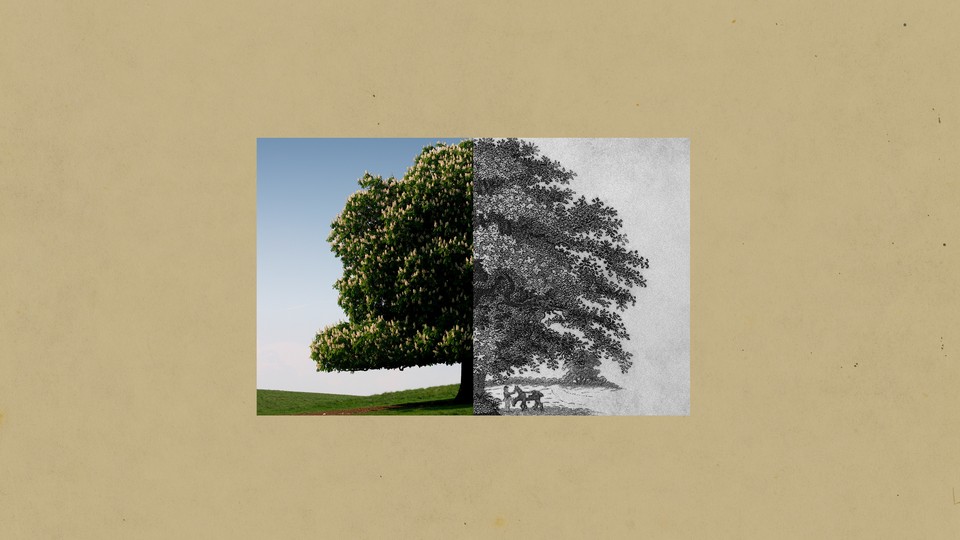 Illustration by The Atlantic. Source: Millennium Images / Gallery Stock; Bettmann/Getty
December 24, 2023, 8 AM ET
Across the Northeast, forests are haunted by the ghosts of American giants. A little more than a century ago, these woods brimmed with American chestnuts—stately Goliaths that could grow as high as 130 feet tall and more than 10 feet wide. Nicknamed “the redwoods of the East,” some 4 billion American chestnuts dotted the United States’ eastern flank, stretching from the misty coasts of Maine down into the thick humidity of Appalachia.
The American chestnut was, as the writer Susan Freinkel noted in her 2009 book, “a perfect tree.” Its wood housed birds and mammals; its leaves infused the soil with minerals; its flowers sated honeybees that would ferry pollen out to nearby trees. In the autumn, its branches would bend under the weight of nubby grape-size nuts. When they dropped to the forest floor, they’d nourish raccoons, bears, turkey, and deer. For generations, Indigenous people feasted on the nuts, split the wood for kindling, and laced the leaves into their medicine. Later on, European settlers, too, introduced the nuts into their recipes and orchards, and eventually learned to incorporate the trees’ sturdy, rot-resistant wood into fence posts, telephone poles, and railroad ties. The chestnut became a tree that could shepherd people “from cradle to grave,” Patrícia Fernandes, the assistant director of the American Chestnut Research and Restoration Project at the State University of New York College of Environmental Science and Forestry, told me. It made up the cribs that newborn babies were placed into; it shored up the coffins that bodies were laid to rest inside.
But in modern American life, chestnuts are almost entirely absent. In the first half of the 20th century, a fungal disease called blight, inadvertently imported from Asia on trade ships, wiped out nearly all of the trees. Chestnut wood disappeared from newly made furniture; people forgot the taste of the fruits, save those imported from abroad. Subsistence farmers lost their entire livelihoods. After reigning over forests for millennia, the species went functionally extinct—a loss that a biologist once declared “the greatest ecological disaster in North America since the Ice Age.”
Most of the people who lived during the American chestnut heyday are gone. But the nutty world they lived in could yet make a comeback. For decades, a small cohort of volunteers and scientists—many of them the children and grandchildren of chestnut growers long gone—has been working to return the American chestnut to its native range. It’s a quest that’s partly about salvaging biodiversity and partly a mea culpa. “The hope is that you can fix something that we as humans broke,” says Kendra Collins, the American Chestnut Foundation’s director of regional programs in New England. If restoration is successful, it’ll bring back a tree unlike any other—versatile, practical, nourishing, uniquely American.
From the December 1874 issue: Old trees
For all of its woes, the American chestnut isn’t technically rare: An estimated 430 million of the trees can still be found in the forests of the American East. But more than 80 percent of these trees never grow past an inch or so in diameter, Sara Fitzsimmons, the American Chestnut Foundation’s chief conservation officer, told me. Blight infiltrates cracks in the bark, essentially girdling the stem until it starves; the roots below can survive to resprout but seldom live long enough to reproduce. Locked into an endless cycle of adolescence, death, and rebirth, the plant can no longer sustain the ecological functions it once did. When the tree went into decline, at least a few animal species that depended on it did too—among them, the American chestnut moth and the Allegheny woodrat, both of which, under additional pressure from deforestation and human encroachment, were driven to near extinction.
Reinstating the American chestnut’s former glory won’t be easy. Blight is now entrenched in North America, impossible to eradicate; the best hope for the trees is to imbue them with pathogen tolerance. Decades ago, that plan seemed simple: All American breeders would need to do, the thinking went, was cross the American species with their naturally more blight-resistant Chinese cousins a few times over, making it possible to pull off “the biggest restoration in history” in as little as two decades, says Brian Clark, the vice president of orchard development for the American Chestnut Foundation’s Massachusetts/Rhode Island chapter. But in recent years, researchers have discovered that the blight resistance is scattered across “just about every chromosome” in the Chinese chestnut genome, Collins told me, making it difficult to reliably breed the trait into mixed-lineage trees. Forty years into its tenure, the foundation has successfully bred a relatively blight-resistant cultivar whose genome is roughly 5 percent Chinese. But the process of producing the trees is a lot more of a pain than researchers hoped.
Read: A new chestnut
Other chestnut enthusiasts have instead hung their hopes on a transgenic tree known as Darling 58, developed by a team of scientists at the State University of New York College of Environmental Science and Forestry. Its genome is entirely American chestnut, save for a single gene, borrowed from wheat, that can help the plant neutralize one of the blight’s most toxic weapons. But with only a single genetic shield against the fungus, “I suspect blight will eventually evolve around” the borrowed gene, says Yvonne Federowicz, the past president of the American Chestnut Foundation’s Massachusetts/Rhode Island chapter. The lineage’s resilience against blight has already been spotty—to the point that the American Chestnut Foundation recently withdrew its support for Darling 58. (The ESF team that designed the Darling trees, meanwhile, stands by them.) And some Indigenous communities have expressed skepticism about introducing GMOs into the chestnut-restoration fight; in 2019, two members of the Foundation’s MA/RI chapter—one of them the chapter’s president—announced their resignation in protest of the organization’s support for transgenic trees.
Regardless of which American-chestnut strains remain in contention, Fitzsimmons told me, restoration could take centuries. Some 100 million acres of suitable chestnut habitat, she said, are waiting to be filled in the United States—no sole solution will likely be enough on its own. But maybe that’s fitting for a tree that refuses to relegate itself to a single purpose. “There are other trees that can produce bigger crops in a given year, or maybe grow taller, or can be more dense, or make more valuable lumber,” Andrew Newhouse, the director of ESF’s American Chestnut Research and Restoration Project, told me. “But not all in the same tree.” The American chestnut is, to our forests and our livelihoods, irreplaceable: “There aren’t really any modern equivalents.”
Read: The fading meaning of ‘GMO’
Chestnuts of any variety are also absolutely delicious—phenomenal plain, roasted, or even raw, thanks to their sweet-savory flavor and starchy texture reminiscent of a baked sweet potato. Japanese speakers often describe them as hoku hoku—hot, fluffy, and flaky, a sensation that’s like a cozy balm on chilly, wintry days, Namiko Hirasawa Chen, the chef behind the food blog Just One Cookbook, told me. In Europe and Asia, where other species of the trees still thrive, days-long festivals have been dedicated to eating chestnuts. Here, though, chestnuts are largely forgotten, save for in nostalgic Christmas songs.
But some people remember. Earlier this month, I drove to Central Massachusetts to attend the American Chestnut Foundation’s MA/RI chapter’s annual meeting, where board members and volunteers had prepared a stunning potluck. Among the tastiest dishes were a creamy chestnut stew, a turkey-chestnut chili, and a cabbage-and-sausage dish studded with chestnuts. Best of all were two desserts: flaky chestnut oat bars that melted like pie crust in my mouth and a luxurious chestnut ice cream that made me forget my lactose intolerance.
As far as I can tell, no one seemed to have bothered cooking with American chestnuts; they’re the smallest of the varieties—some as teeny as chickpeas—and not efficient to work with. But at the close of the meeting, a local grower, Mark Meehl, handed me a bag of Americans from his Massachusetts orchards. The next evening, I scored them, parboiled them, and roasted them next to some gargantuan Europeans, easily six times their size. It was, admittedly, a lot of work. But it made each nut precious, almost like a hard-won prize.
From the August 1897 issue: John Muir’s case for saving American forests
When I pried the Americans open, I found them to be consistently sweeter, crunchier, and, well, nuttier than their European counterparts. And although several of the European chestnuts—imported from Italy—appeared to have rotted during their long journey to my oven, every American nut was fresh. Not a single one of them had traveled more than 50 miles from its source. I scarfed all 10 of them down, and only wished I could have strolled into the woods near my house to gather up some more.
>>> Read full article>>>
Copyright for syndicated content belongs to the linked Source : Hacker News – https://www.theatlantic.com/science/archive/2023/12/american-chestnut-perfect-tree-restoration/676927/



