







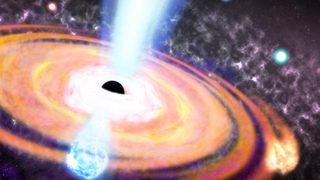
An illustration shows the magnetic fields of an early supermassive black hole driving star formation.
(Image credit: Roberto Molar Candanosa/Johns Hopkins University)
“What came first, the galaxy or its monster black hole?”
Technically, it’s an even more ancient riddle than the one about the chicken or the egg — though we’ve only relatively recently become aware of it. And, according to new research, scientists may finally have an answer.
Supermassive black holes that existed close to the dawn of time have long been believed to have shaped the galaxies around them, accelerating the galaxies’ rates of star formation and thereby influencing the evolution of the entire universe. But now, a reanalysis of data from the James Webb Space Telescope (JWST) indicates that these black holes could have been present during the first 50 million years of our 13.8 billion-year-old universe, driving star formation at such an early age.
The findings could challenge the idea that black holes formed only after the first stars and galaxies emerged.
Related: Is a black hole stuck inside the sun? No, but here’s why scientists are asking
“We know these monster black holes exist at the center of galaxies near our Milky Way, but the big surprise now is that they were present at the beginning of the universe as well and were almost like building blocks or seeds for early galaxies,” Joseph Silk, team leader and a professor at Johns Hopkins University, said in a statement. “They really boosted everything, like gigantic amplifiers of star formation, which is a whole turnaround of what we thought possible before — so much so that this could completely shake up our understanding of how galaxies form.”
Related: Scientists find black hole powering a molecular gas fountain in the ancient universe
Silk points to the fact that distant and early galaxies the JWST has been looking at, since it started sending data to Earth in the summer of 2022, are brighter than expected.
This suggests the galaxies are already replete with unusually high numbers of stars and supermassive black holes; if true, that’d mean our current theories of how galaxies grow may need revision.
“We’re arguing that black hole outflows crushed gas clouds, turning them into stars and greatly accelerating the rate of star formation,” Silk said. “Otherwise, it’s very hard to understand where these bright galaxies came from because they’re typically smaller in the early universe. Why on earth should they be making stars so rapidly?”
Currently, the most widely accepted theories of cosmic evolution suggest early universe black holes were born when highly massive stars ran out of their fuel supplies needed for nuclear fusion. In turn, those stars would’ve collapsed and created black holes in later epochs of the universe. This means the black holes would have had to come after the formation of the stars that birthed them, as well as before the first gatherings of galaxies.
Yet, Silk and colleagues found that black holes and galaxies seem to have coexisted during the ancient universe, influencing each other as early as 100 million years after the Big Bang. This time period, Silk says, would be equivalent to merely the first days of January if the history of the universe were condensed to a calendar year.
Crushing it in the early universe
The immense gravitational influence of black holes means that nothing (not even light) can escape its outer boundary, known as the event horizon. What this means for us is that whatever lies beyond that boundary can’t be seen directly.
But beyond the event horizon, things still happen. A black hole’s gravity is still intense enough to generate violent conditions for any surrounding matter with the misfortune of falling too close to the event horizon, heating it and causing it to flow brightly. This matter can be swallowed, or it can be channeled to the poles of the black hole, where it is blasted out at near-light speeds as jets or winds.
Black holes actively feeding on matter like that can power what are known as active galactic nuclei (AGN), or regions within galaxies that can outshine the combined light of every star in the galaxies themselves.
Silk thinks the fact that black holes act like “cosmic particle accelerators” in this way is what enabled the JWST to spot so many in the early universe.
“We can’t quite see these violent winds or jets far, far away, but we know they must be present because we see many black holes early on in the universe,” Silk explained. “These enormous winds coming from the black holes crush nearby gas clouds and turn them into stars. That’s the missing link that explains why these first galaxies are so much brighter than we expected.”

An artist’s impression of active galactic nucleus shows its bright emissions which may explain why the JWST saw so many bright early galaxies. (Image credit: ESA/NASA, the AVO project and Paolo Padovani)
The universe was going through a phase (or two)
The team behind this research theorized that the early universe had two distinct phases. The first phase would have seen high-speed outflows from black holes accelerating the birth of stars. The second phase would have begun when these outflows petered out.
Following this, when the universe was around a few hundred million years old, massive gas clouds would have been forced to collapse via intense magnetic storms caused by supermassive black holes. This would have triggered a new period of intense and rapid star formation that far outstripped rates of star birth seen in more modern galaxies.
Star formation would then have been stymied because massive outflows from supermassive black holes would’ve transitioned into a state that conserved energy, cutting off the gas supply in galaxies where stars could form.
“We thought that in the beginning, galaxies formed when a giant gas cloud collapsed,” Silk explained. “The big surprise is that there was a seed in the middle of that cloud — a big black hole — and that helped rapidly turn the inner part of that cloud into stars at a rate much greater than we ever expected. And so the first galaxies are incredibly bright.”
Not only does the team think future JWST data could provide more accurate early star and supermassive black hole counts that will confirm the new theory, but the researchers also believe the $10 billion space telescope can deliver some answers to fundamental questions found closer to home.
“The big question is, what were our beginnings? The sun is one star in 100 billion in the Milky Way galaxy, and there’s a massive black hole sitting in the middle, too. What’s the connection between the two?” Silk concluded. “Within a year, we’ll have so much better data and a lot of our questions will begin to get answers.”
The team’s research was published in January in the Astrophysical Journal Letters.
Join our Space Forums to keep talking space on the latest missions, night sky and more! And if you have a news tip, correction or comment, let us know at: [email protected].
Breaking space news, the latest updates on rocket launches, skywatching events and more!
Robert Lea is a science journalist in the U.K. whose articles have been published in Physics World, New Scientist, Astronomy Magazine, All About Space, Newsweek and ZME Science. He also writes about science communication for Elsevier and the European Journal of Physics. Rob holds a bachelor of science degree in physics and astronomy from the U.K.’s Open University. Follow him on Twitter @sciencef1rst.
>>> Read full article>>>
Copyright for syndicated content belongs to the linked Source : Space.com – https://www.space.com/james-webb-space-telescope-black-holes-galaxies-first



