





* . *
  • About
  • Advertise
  • Privacy & Policy
  • Contact
Monday, March 2, 2026
Earth-News
  • Home
  • Business
  • Entertainment

    BIG 12 ANNOUNCES FAN EXPERIENCES, ENTERTAINMENT AND COMMUNITY PROGRAMMING FOR 2026 PHILLIPS 66 BIG 12 MEN’S AND WOMEN’S BASKETBALL TOURNAMENTS – Big 12 Conference

    Get Ready for an Exciting Weekend Filled with Theater, Concerts, and a Film Festival!

    Australian casino operator Star Entertainment’s first-half loss narrows – Reuters

    Golden Entertainment, Inc. (GDEN) director receives RSUs and common shares – Stock Titan

    What the Future Holds for UK Entertainment in 2025

    Discover the All-New ‘ABC Entertainment Update’ Podcast – Your Ultimate Source for the Latest in TV!

  • General
  • Health
  • News

    Cracking the Code: Why China’s Economic Challenges Aren’t Shaking Markets, Unlike America’s” – Bloomberg

    Trump’s Narrow Window to Spread the Truth About Harris

    Trump’s Narrow Window to Spread the Truth About Harris

    Israel-Gaza war live updates: Hamas leader Ismail Haniyeh assassinated in Iran, group says

    Israel-Gaza war live updates: Hamas leader Ismail Haniyeh assassinated in Iran, group says

    PAP Boss to Niger Delta Youths, Stay Away from the Protest

    PAP Boss to Niger Delta Youths, Stay Away from the Protest

    Court Restricts Protests In Lagos To Freedom, Peace Park

    Court Restricts Protests In Lagos To Freedom, Peace Park

    Fans React to Jazz Jennings’ Inspiring Weight Loss Journey

    Fans React to Jazz Jennings’ Inspiring Weight Loss Journey

    Trending Tags

    • Trump Inauguration
    • United Stated
    • White House
    • Market Stories
    • Election Results
  • Science
  • Sports
  • Technology

    DNB Asset Management Amplifies Seagate Technology Stake with $10.85 Million Investment

    Trump Calls for Immediate Ban on Anthropic AI Technology in US Agencies Over Ethical Fears

    India and Israel Forge Stronger Alliance in Defence and Technology Innovation

    How NVIDIA’s Evolution into the “Berkshire of Technology” Could Unlock Huge Shareholder Gains

    Trump Media & Technology Group Under Fire for Algorithmic Misconduct: Impact on Its Valuation Explained

    Flexport Launches Groundbreaking Technology to Automate Tariff Refunds

    Trending Tags

    • Nintendo Switch
    • CES 2017
    • Playstation 4 Pro
    • Mark Zuckerberg
No Result
View All Result
  • Home
  • Business
  • Entertainment

    BIG 12 ANNOUNCES FAN EXPERIENCES, ENTERTAINMENT AND COMMUNITY PROGRAMMING FOR 2026 PHILLIPS 66 BIG 12 MEN’S AND WOMEN’S BASKETBALL TOURNAMENTS – Big 12 Conference

    Get Ready for an Exciting Weekend Filled with Theater, Concerts, and a Film Festival!

    Australian casino operator Star Entertainment’s first-half loss narrows – Reuters

    Golden Entertainment, Inc. (GDEN) director receives RSUs and common shares – Stock Titan

    What the Future Holds for UK Entertainment in 2025

    Discover the All-New ‘ABC Entertainment Update’ Podcast – Your Ultimate Source for the Latest in TV!

  • General
  • Health
  • News

    Cracking the Code: Why China’s Economic Challenges Aren’t Shaking Markets, Unlike America’s” – Bloomberg

    Trump’s Narrow Window to Spread the Truth About Harris

    Trump’s Narrow Window to Spread the Truth About Harris

    Israel-Gaza war live updates: Hamas leader Ismail Haniyeh assassinated in Iran, group says

    Israel-Gaza war live updates: Hamas leader Ismail Haniyeh assassinated in Iran, group says

    PAP Boss to Niger Delta Youths, Stay Away from the Protest

    PAP Boss to Niger Delta Youths, Stay Away from the Protest

    Court Restricts Protests In Lagos To Freedom, Peace Park

    Court Restricts Protests In Lagos To Freedom, Peace Park

    Fans React to Jazz Jennings’ Inspiring Weight Loss Journey

    Fans React to Jazz Jennings’ Inspiring Weight Loss Journey

    Trending Tags

    • Trump Inauguration
    • United Stated
    • White House
    • Market Stories
    • Election Results
  • Science
  • Sports
  • Technology

    DNB Asset Management Amplifies Seagate Technology Stake with $10.85 Million Investment

    Trump Calls for Immediate Ban on Anthropic AI Technology in US Agencies Over Ethical Fears

    India and Israel Forge Stronger Alliance in Defence and Technology Innovation

    How NVIDIA’s Evolution into the “Berkshire of Technology” Could Unlock Huge Shareholder Gains

    Trump Media & Technology Group Under Fire for Algorithmic Misconduct: Impact on Its Valuation Explained

    Flexport Launches Groundbreaking Technology to Automate Tariff Refunds

    Trending Tags

    • Nintendo Switch
    • CES 2017
    • Playstation 4 Pro
    • Mark Zuckerberg
No Result
View All Result
Earth-News
No Result
View All Result
Home Health

A short history of sunscreen, from basting like a chook to preventing skin cancer

December 28, 2023
in Health
A short history of sunscreen, from basting like a chook to preventing skin cancer
Share on FacebookShare on Twitter

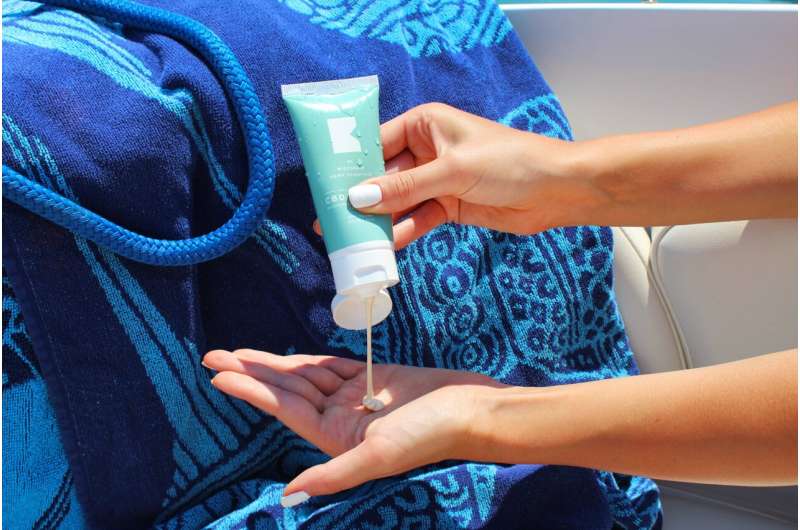
sunscreen

Credit: Unsplash/CC0 Public Domain

Australians have used commercial creams, lotions or gels to manage our skin’s sun exposure for nearly a century.

But why we do it, the preparations themselves, and whether they work, has changed over time.

In this short history of sunscreen in Australia, we look at how we’ve slathered, slopped and spritzed our skin for sometimes surprising reasons.

At first, suncreams helped you ‘tan with ease’

Sunscreens have been available in Australia since the 30s. Chemist Milton Blake made one of the first.

He used a kerosene heater to cook batches of “sunburn vanishing cream”, scented with French perfume.

His backyard business became H.A. Milton (Hamilton) Laboratories, which still makes sunscreens today.

Hamilton’s first cream claimed you could ” Sunbathe in Comfort and TAN with ease”. According to modern standards, it would have had an SPF (or sun protection factor) of 2.

The mirage of ‘safe tanning’

A tan was considered a “modern complexion” and for most of the 20th century, you might put something on your skin to help gain one. That’s when “safe tanning” (without burning) was thought possible.

Sunburn was known to be caused by the UVB component of ultraviolet (UV) light. UVA, however, was thought not to be involved in burning; it was just thought to darken the skin pigment melanin. So, medical authorities advised that by using a sunscreen that filtered out UVB, you could “safely tan” without burning.

But that was wrong.

From the 70s, medical research suggested UVA penetrated damagingly deep into the skin, causing aging effects such as sunspots and wrinkles. And both UVA and UVB could cause skin cancer.

Sunscreens from the 80s sought to be “broad spectrum”—they filtered both UVB and UVA.

Researchers consequently recommended sunscreens for all skin tones, including for preventing sun damage in people with dark skin.

Delaying burning … or encouraging it?

Up to the 80s, sun preparations ranged from something that claimed to delay burning, to preparations that actively encouraged it to get that desirable tan—think, baby oil or coconut oil. Sun-worshippers even raided the kitchen cabinet, slicking olive oil on their skin.

One manufacturer’s “sun lotion” might effectively filter UVB; another’s merely basted you like a roast chicken.

Since labeling laws before the 80s didn’t require manufacturers to list the ingredients, it was often hard for consumers to tell which was which.

At last, SPF arrives to guide consumers

In the 70s, two Queensland researchers, Gordon Groves and Don Robertson, developed tests for sunscreens—sometimes experimenting on students or colleagues. They printed their ranking in the newspaper, which the public could use to choose a product.

An Australian sunscreen manufacturer then asked the federal health department to regulate the industry. The company wanted standard definitions to market their products, backed up by consistent lab testing methods.

In 1986, after years of consultation with manufacturers, researchers and consumers, Australian Standard AS2604 gave a specified a testing method, based on the Queensland researchers’ work. We also had a way of expressing how well sunscreens worked—the sun protection factor or SPF.

This is the ratio of how long it takes a fair-skinned person to burn using the product compared with how long it takes to burn without it. So a cream that protects the skin sufficiently so it takes 40 minutes to burn instead of 20 minutes has an SPF of 2.

Manufacturers liked SPF because businesses that invested in clever chemistry could distinguish themselves in marketing. Consumers liked SPF because it was easy to understand—the higher the number, the better the protection.

Australians, encouraged from 1981 by the Slip! Slop! Slap! nationwide skin cancer campaign, could now “slop” on a sunscreen knowing the degree of protection it offered.

How about skin cancer?

It wasn’t until 1999 that research proved that using sunscreen prevents skin cancer. Again, we have Queensland to thank, specifically the residents of Nambour. They took part in a trial for nearly five years, carried out by a research team led by Adele Green of the Queensland Institute of Medical Research. Using sunscreen daily over that time reduced rates of squamous cell carcinoma (a common form of skin cancer) by about 60%.

Follow-up studies in 2011 and 2013 showed regular sunscreen use almost halved the rate of melanoma and slowed skin aging. But there was no impact on rates of basal cell carcinoma, another common skin cancer.

By then, researchers had shown sunscreen stopped sunburn, and stopping sunburn would prevent at least some types of skin cancer.

What’s in sunscreen today?

An effective sunscreen uses one or more active ingredients in a cream, lotion or gel. The active ingredient either works:

“chemically” by absorbing UV and converting it to heat. Examples include PABA (para-aminobenzoic acid) and benzyl salicylate, or

“physically” by blocking the UV, such as zinc oxide or titanium dioxide.

Physical blockers at first had limited cosmetic appeal because they were opaque pastes. (Think cricketers with zinc smeared on their noses.)

With microfine particle technology from the 90s, sunscreen manufacturers could then use a combination of chemical absorbers and physical blockers to achieve high degrees of sun protection in a cosmetically acceptable formulation.

Where now?

Australians have embraced sunscreen, but they still don’t apply enough or reapply often enough.

Although some people are concerned sunscreen will block the skin’s ability to make vitamin D this is unlikely. That’s because even SPF50 sunscreen doesn’t filter out all UVB.

There’s also concern about the active ingredients in sunscreen getting into the environment and whether their absorption by our bodies is a problem.

Sunscreens have evolved from something that at best offered mild protection to effective, easy-to-use products that stave off the harmful effects of UV. They’ve evolved from something only people with fair skin used to a product for anyone.

Remember, slopping on sunscreen is just one part of sun protection. Don’t forget to also slip (protective clothing), slap (hat), seek (shade) and slide (sunglasses).

This article is republished from The Conversation under a Creative Commons license. Read the original article.The Conversation

Citation:
A short history of sunscreen, from basting like a chook to preventing skin cancer (2023, December 27)
retrieved 27 December 2023
from https://medicalxpress.com/news/2023-12-short-history-sunscreen-basting-chook.html

This document is subject to copyright. Apart from any fair dealing for the purpose of private study or research, no
part may be reproduced without the written permission. The content is provided for information purposes only.

>>> Read full article>>>
Copyright for syndicated content belongs to the linked Source : Medical Xpress – https://medicalxpress.com/news/2023-12-short-history-sunscreen-basting-chook.html


Tags: healthhistory’short
Previous Post

Death Risk Takes Decades to Revert to Normal in Ex-Smokers

Next Post

‘Financial ruin is baked into the system’: Readers on the costs of long-term care

OLCHS Science Chair Michael Bielski Teaches Students Lessons In Ecology From the Heart – Patch

March 2, 2026

How Sahara Desert Dust Nourishes the Amazon: Unveiling the Science Behind a 10,000-Mile Journey

March 2, 2026

The Surprisingly Adorable Reason Cats Love Sleeping on One Side

March 2, 2026

Explore the Best Local Beer, Music, and Entertainment Happening in Whatcom County This Weekend!

March 2, 2026

How Trump and Netanyahu Unite to Defend the Free World Against Iran

March 2, 2026

Arctic Climate Feedback Loop Threatens Michigan’s Tourism, Manufacturing, and Great Lakes Economy

March 2, 2026

BIG 12 ANNOUNCES FAN EXPERIENCES, ENTERTAINMENT AND COMMUNITY PROGRAMMING FOR 2026 PHILLIPS 66 BIG 12 MEN’S AND WOMEN’S BASKETBALL TOURNAMENTS – Big 12 Conference

March 1, 2026

The Shocking Decline in Healthy Life Expectancy in Britain Demands Immediate Action

March 1, 2026

Inside the Mind of Political Analyst Alex Penelas: Exclusive Insights Revealed

March 1, 2026

DNB Asset Management Amplifies Seagate Technology Stake with $10.85 Million Investment

March 1, 2026

Categories

Archives

March 2026
M T W T F S S
 1
2345678
9101112131415
16171819202122
23242526272829
3031  
« Feb    
Earth-News.info

The Earth News is an independent English-language daily published Website from all around the World News

Browse by Category

  • Business (20,132)
  • Ecology (1,097)
  • Economy (1,115)
  • Entertainment (21,992)
  • General (20,173)
  • Health (10,155)
  • Lifestyle (1,130)
  • News (22,149)
  • People (1,120)
  • Politics (1,132)
  • Science (16,330)
  • Sports (21,617)
  • Technology (16,097)
  • World (1,107)

Recent News

OLCHS Science Chair Michael Bielski Teaches Students Lessons In Ecology From the Heart – Patch

March 2, 2026

How Sahara Desert Dust Nourishes the Amazon: Unveiling the Science Behind a 10,000-Mile Journey

March 2, 2026
  • About
  • Advertise
  • Privacy & Policy
  • Contact

© 2023 earth-news.info

No Result
View All Result

© 2023 earth-news.info

No Result
View All Result

© 2023 earth-news.info

Go to mobile version
