















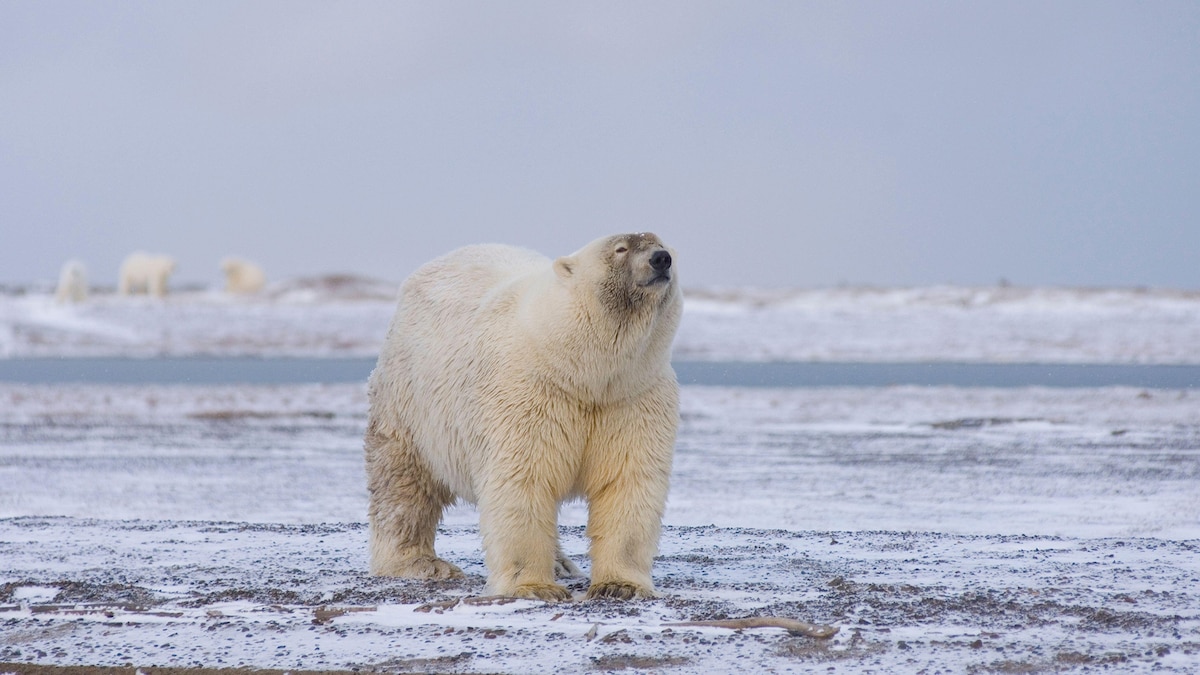
In 2006, a hunter in Canada’s Northwest Territories shot a bear that had white fur with brown patches, long claws, and a grizzly-like hump. The strange-looking bear turned out to be a hybrid: a cross between a polar bear and a grizzly bear.
Over the following years, scientists identified a total of eight polar-grizzly hybrids, and found all the animals were descendants of the same female polar bear. Sometimes called “grolars” when the father is a grizzly bear or a “pizzlies” when the father is a polar bear, these bears made headlines, and some researchers warned that the Arctic could become prime territory for hybrids due to climate change.

Hybrid bear cubs (two shown) were born to a Kodiak bear mother and a polar bear father at the National Zoo in 1937.
Photograph By J. Baylor Roberts, Nat Geo Image Collection
“We’re interested in assessing the hybridization rate because we know that as the climate is warming in the Arctic, grizzly bears and polar bears are coming more and more into contact with one another,” says Ruth Rivkin, an evolutionary biologist at the University of Manitoba. Using genetic tools, Rivkin and her colleagues recently found that hybridization remains rare among polar bears—for now.
Bears aren’t the only Arctic species that have intermingled, and many of these hybrids are virtually indistinguishable by sight. That’s why genetic analyses have become incredibly important. Scientists are looking deep into animals’ DNA to identify and learn more about potential hybrids, often raising more questions than answers.
Unmasking hybrids
Typically, animals don’t mate outside their species, due to a variety of barriers, including geography. But hybrids can arise when species or subspecies that would not normally overlap run into each other when searching for a mate. (Read more about how hybrids happen.)
Beluga whales and narwhals split on the evolutionary tree around five million years ago, but sometimes the species cross paths in western Greenland’s Disko Bay. In the 1980s, a hunter collected an unusual skull that researchers later hypothesized belonged to a beluga-narwhal hybrid.
“This was the early days of genetics, and getting DNA from a skull that had been sitting for three to five years outside just wasn’t really an option in the early part of the ‘90s,” says Mikkel Skovrind, a geneticist at the University of Copenhagen who helped evaluate the skull with modern genetic techniques in 2019. The study confirmed the identity of the “narluga” hybrid and pegged its birth to the 1970s or earlier.

As temperatures warm, grizzly bears (Ursus arctos horribilis, female shown with a cub) may move further north, bringing them closer to polar bear territory.
Photograph By John Eastcott and Yva Momatiuk, Nat Geo Image collection

Similarly, melting sea ice in the Arctic could drive polar bears (Ursus maritimus, female shown with cubs) further south in search of food.
Photograph By Florian Schulz, Nat Geo Image Collection

Beluga whales (Delphinapterus leucas) overlap during mating season with narwhals at Disko Bay in western Greenland.
Photograph By Brian Skerry, Nat Geo Image Collection

The narluga whale hybrid from Disko Bay, a male, lacked the iconic tusk for which male narwhals (Monodon monoceros, shown) are known.
Photograph By Paul Nicklen, Nat Geo Image Collection
Climate connections
While some Arctic hybrids arise from chance encounters, warming temperatures and melting sea ice could remove a substantial barrier to species coming into contact with each other. Sea ice losses could drive polar bears to new locations in search of food, and climate change could also shift grizzly habitats north, resulting in the species sharing more space during mating season.
To see if new hybrids were popping up, Rivkin and her colleagues examined DNA samples collected from bears in Canada, Alaska, and Greenland from 1975 to 2015, looking for genes from polar, grizzly, and hybrid bears. Out of the more than 800 samples they examined, researchers only found the eight hybrids they already knew about.
“I was surprised,” says Rivkin. “It would be really hard to visually distinguish hybrids from grizzly bears or polar bears, and so I had sort of expected to see these hidden hybrids showing up genetically. But based on our findings, we think that hybridization is pretty rare.”
Still, the existing hybrid bears are likely the result of warming temperatures, which will remain a problem in the future. “We need to continue monitoring these bears to make sure that if there is hybridization happening we can adjust our conservation and management strategies accordingly,” says Rivkin.
Evidence has linked climate to other Arctic hybridizations. Researchers recently traced the history of a hybrid population of Atlantic puffins on an island in Norway’s Svalbard archipelago. Their results showed that two subspecies had hybridized sometime since 1910, as a larger-bodied subspecies shifted its range south. The authors wrote, “the emergence of this hybrid population coincides precisely with the anthropogenic warming of the Arctic.”
Going back even further, some researchers suspect that polar bears and brown bears actually split 600,000 years ago and continued to intermix when ancient climate shifts overlapped their territories. Estimates for the species’ split range from 70,000 to 5 million years ago, but some modern populations of Alaskan brown bears may have even retained polar bear genes.

Atlantic puffins live on the fringes of the Arctic (one shown in Iceland). Two subspecies hybridized sometime since 1910, after the larger of the two subspecies shifted south. The hybrid birds now populate Bjørnøya, the southernmost island in Norway’s Svalbard archipelago.
Photograph By Thomas Peschak, Nat Geo Image Collection
Is hybridization a good thing?
Swapping genes with another species or subspecies has pros and cons, and the negative effects of hybridization are particularly concerning for species at risk of extinction.
Rather than becoming “super animals” inheriting all the best traits from each parent species, hybrid animals can be at a disadvantage. While early generations of hybrid species might have “hybrid vigor” and produce fitter offspring, later generations may suffer from “outbreeding depression” resulting in lower fitness and reproductive rates. Conservationists also worry that legal conservation frameworks may not apply to hybrid animals.
Endangered blue whales do not technically live in the Arctic Ocean but are found in the North Atlantic above the Arctic Circle. A recent study found that around 3.5 percent of the North Atlantic population’s genetic blueprint derives from fin whales.
“That 3.5 percentage is a lot,” says Mark Engstrom, who is curator emeritus at Toronto’s Royal Ontario Museum and an author on the study. “It represents significant input of fin whale into blue whale populations.”
One concern is “genetic swamping”, when the genes of one species are overwhelmed by the genes of another species. This onslaught has raised the extinction risk for Scotland’s European wildcats. Engstrom says the current evidence does not show whether or not the level of hybridization in blue whales negatively impacts the species.
For vulnerable Atlantic puffins, the impact is also yet to be determined. “This is the million dollar question, in a way, at least for the puffins: Is this beneficial, or is this detrimental? Generally speaking, hybridization can result in… either one,” says Oliver Kersten, a researcher at the University of Oslo who worked on the puffin study.
Though genetic studies are providing some answers to hybrid mysteries, researchers still have questions: Will some hybrid species in the Arctic end up with a traits poorly suited to their habitat? Will some have low reproductive rates or be infertile? Researchers also want to know how many hybrids are out there, and how climate change might impact these species.
Engstrom points to his whale research, saying, “None of these studies are an endpoint… They often raise many more questions than they answer.”
>>> Read full article>>>
Copyright for syndicated content belongs to the linked Source : National Geographic – https://www.nationalgeographic.com/animals/article/arctic-hybrid-polar-grizzly-bear-genetics-climate