







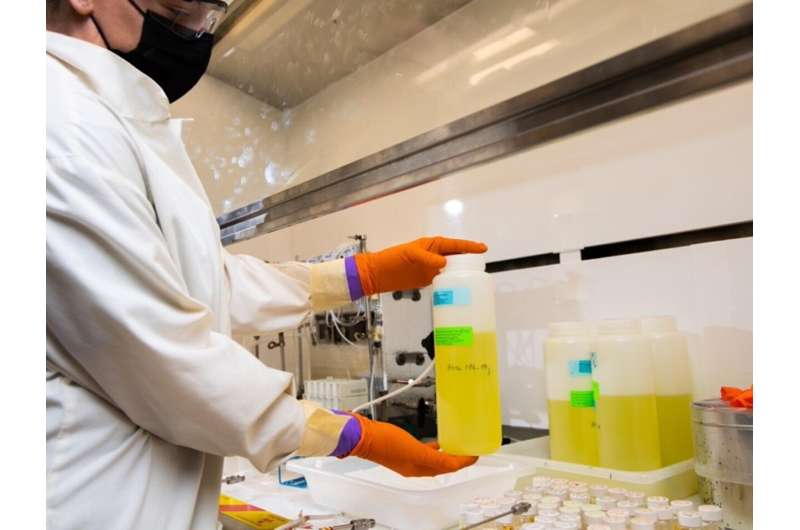
Safe and effective ways to process the Hanford Site’s radioactive tank waste, especially to remove cesium as an important pre-treatment step, is researched and developed in the Radiochemical Processing Laboratory at Pacific Northwest National Laboratory. These bottles contain tank waste after the cesium has been removed. Credit: Andrea Starr | Pacific Northwest National Laboratory
Fifty-six million gallons. That is the amount of radioactive tank waste left behind at the Hanford Site as a result of the secret government mission to provide the plutonium for the world’s first atomic weapons and the Cold War that followed. Today, the Hanford Site is known as one of the world’s most technically complex environmental challenges.
“The amount of legacy waste that has to be processed and the cost of doing that is astronomical. It’s a huge amount of money and until that problem is solved, we’ll have to keep monitoring the tanks,” said Reid Peterson, chemical engineer at Pacific Northwest National Laboratory (PNNL).
Peterson has spent nearly three decades working on tank waste issues for Department of Energy (DOE) Office of Environment Management sites. He was part of a national response to control benzene gas burps in a Savannah River Site waste tank from reaching flammable limits. He helped develop different chemical separation techniques. But among his many contributions to the challenge of cleaning up such chemically complex radioactive waste, one effort stands above others: capturing cesium-137.
Cesium-137 is mostly human-made. It is found in large quantities in nuclear waste because it’s a byproduct of making plutonium, a necessary step in nuclear weapons production. Scientists have discovered how to safely store this radioactive waste in glass, but before that can happen a portion of the liquid tank waste needs to be treated to remove most of the cesium-137.
That’s because the type of gamma radiation it emits—energy higher than X-rays—can penetrate through the human body and even through steel, making it too dangerous for workers to operate and maintain the processing technology used to make low-activity waste glass. That’s been Peterson’s challenge for over a decade. As of today, with supporting research from PNNL, staff at Hanford have removed cesium from more than 697,000 gallons of tank waste—a significant milestone in cleanup progress at Hanford.
The evolution of cesium removal technology
In 2008, Peterson and other researchers at PNNL successfully demonstrated in a pilot project that they could remove cesium using a system set next to a nuclear waste tank. Plugging a removal system directly into a single tank was shown to be a cost-effective approach.
The demonstration proved important when three short years later, an earthquake and resulting tsunami caused a nuclear meltdown at the Fukushima Daiichi nuclear power plant in Japan. Cesium removal technology had to be accelerated and deployed quickly in response to the accident.
“Within days after the event, I headed to DC to do a review of what technology should be used,” said Peterson. “I went several times to Fukushima to review their cesium removal technologies. We would pass the reactors that had blown up and my dosimeter would ping as we drove by because there was so much radiation.”
The team received a DOE Secretary’s Award in 2011 for that response.
The Fukushima cleanup efforts served as a catalyst for deploying similar systems at the Savannah River Site and eventually at Hanford. In-real time, the world was seeing the effectiveness of the technology.
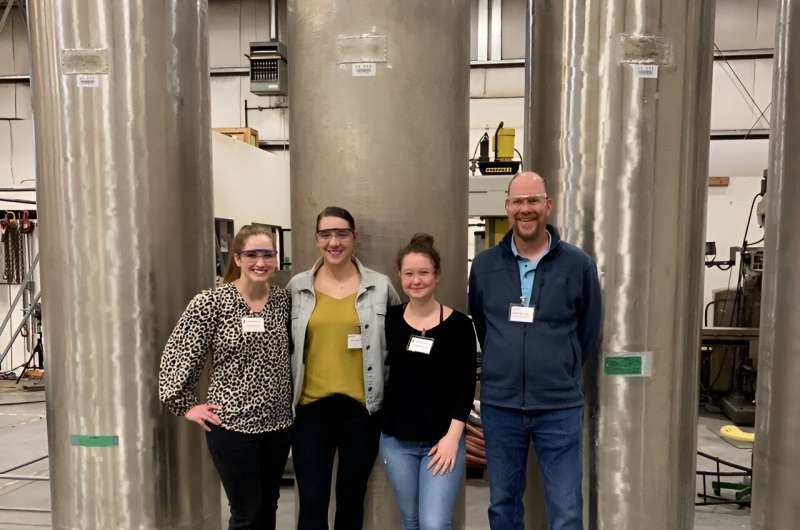
PNNL researchers Emily Campbell, Amy Westesen, Ashley Williams, and Reid Peterson stand in front of the columns used within the Tank-Side Cesium Removal (TSCR) system. Credit: Reid Peterson | Pacific Northwest National Laboratory
Removing cesium, five gallons per minute
Peterson is the project manager who brought the cesium removal technology from bench scale to full height demonstration, giving the tank farm operator confidence to proceed with full-scale operations. At the Hanford Site, it is called the Tank-Side Cesium Removal (TSCR) system.
TSCR pretreats waste in a system built inside a shipping container, where steel columns are placed inside with a forklift. Tank waste feeds through a filter and flows into a column. Inside the column is ion exchange media, consisting of a mixture of silica and titanium as the main ingredients. The ion exchange media resembles small white beads and though small, they have a mighty power—capturing cesium.
“This stuff loves cesium,” Peterson said of the ion exchange media. “As the liquid flows through the filter and into the column, the media soaks up most of it.”
It’s an intricate balance of getting the speed of the liquid flow just right so that the media has enough time to soak up the cesium.
Peterson and his team at PNNL mimic TSCR on a smaller scale in a special lab set-up on the Hanford Site called the Radioactive Waste Test Platform.
“With the Radioactive Waste Test Platform, we know for sure that TSCR is working the way it’s supposed to because we have all this lab data that lines up perfectly with the system performance,” he said.
Once the column is full, the system is paused and the column is replaced with another. The Hanford TSCR system has been operating since January 2022. It can run 24/7 at a flow rate of 5 gallons of waste pretreated per minute. But what happens to the waste once it is pretreated?
The Radioactive Waste Test Platform at Pacific Northwest National Laboratory is a key capability for supporting vitrification waste treatment operations at the Department of Energy’s Hanford Site. This technology helps to reduce the cost and schedule risks of cleanup by demonstrating baseline treatment and potential alternatives. This enables scientists, engineers, and officials to evaluate technology maturation and alternative strategies, and to optimize cleanup operations. Credit: Pacific Northwest National Laboratory
From radioactive liquid to stable glass
TSCR is step one in the larger goal to stabilize liquid waste into glass—literally making it part of the glass structure—using a process called vitrification. Staff at Hanford will use vitrification technology to mix pretreated waste with glass-forming materials, heat it to over 1,150°C in a high-temperature melter, and pour the molten glass into large steel vessels where it cools and solidifies for long-term disposal.
“Before the Hanford ‘Vit Plant’ starts up, 800,000 gallons of tank waste needs to be pretreated and ready to go,” Peterson said.
Pretreatment is a vital step for two main reasons: safety and cost.
“We want to be able to do contact maintenance on the equipment as opposed to having to do everything remotely,” Peterson said. “Without cesium being removed first, you would have to have a 6-foot-thick wall of concrete protection and the whole design concept would have to change, leading to higher costs as well.”
The Hanford Vit Plant, formally called the Waste Treatment and Immobilization Plant, is currently scheduled to begin operating in 2025. Although more than 697,000 gallons is a major milestone, it is only a small dent in the waste still awaiting pretreatment. A follow-up project could possibly speed up the pretreatment process by bringing TSRC to a much larger scale.
“I started this career 29 years ago and have stuck with it because it is a major problem to solve,” said Peterson, who was recently honored for this dedication to chemical engineering by the AIChE Nuclear Engineering Division with the Robert E. Wilson Award.
“I get a note every day with how many gallons TSCR has processed,” he said. “To be able to support something that is up and running— and running effectively— feels like we are making really important progress.”
Citation:
Removing cesium: Solutions to a chemically complex problem (2023, November 16)
retrieved 17 November 2023
from https://phys.org/news/2023-11-cesium-solutions-chemically-complex-problem.html
This document is subject to copyright. Apart from any fair dealing for the purpose of private study or research, no
part may be reproduced without the written permission. The content is provided for information purposes only.
>>> Read full article>>>
Copyright for syndicated content belongs to the linked Source : Phys.org – https://phys.org/news/2023-11-cesium-solutions-chemically-complex-problem.html



